Home
About This Textbook
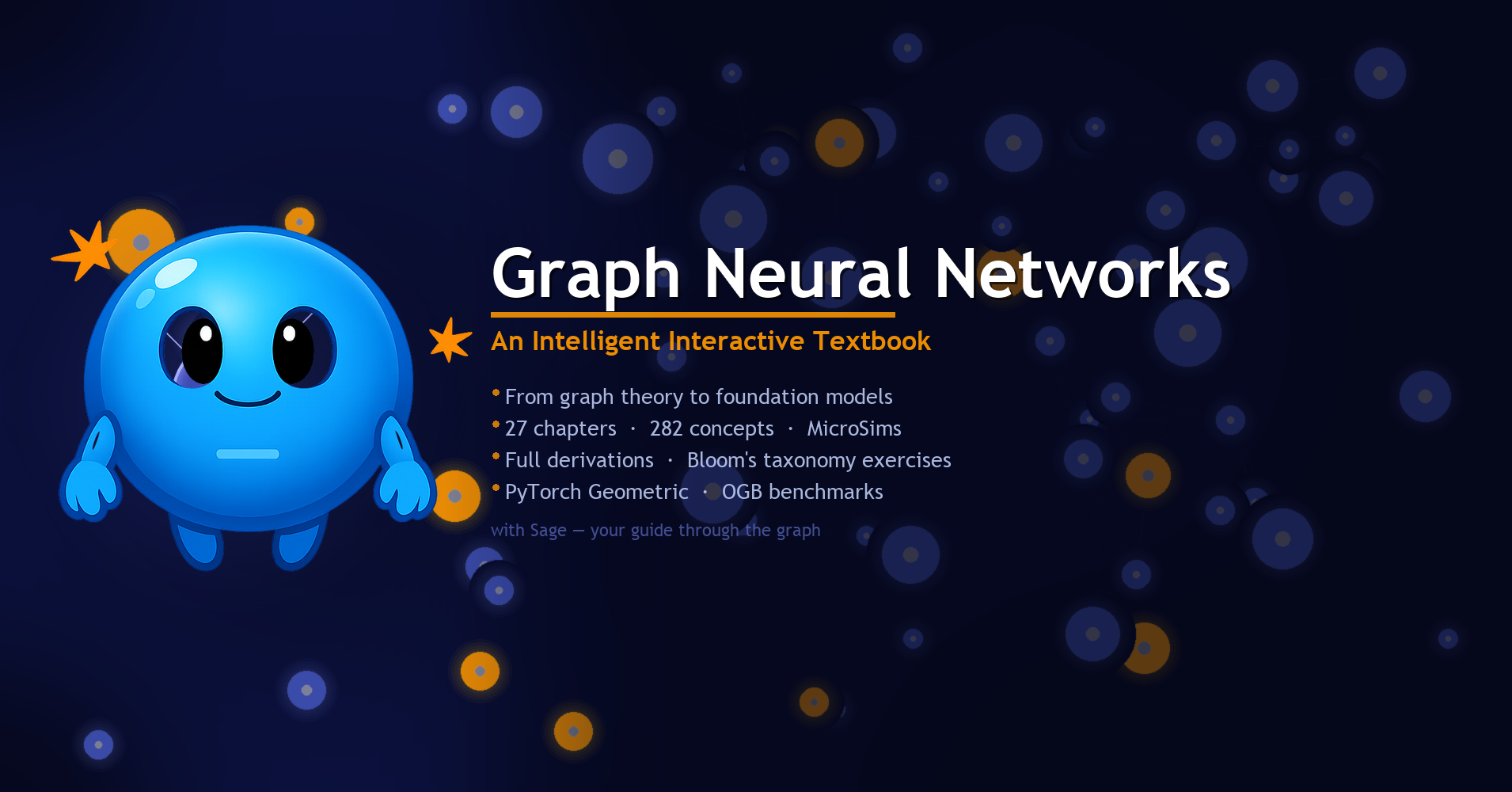
This textbook covers Graph Neural Networks from the ground up — starting with graph theory and classical graph algorithms, building through node embeddings and spectral methods, and reaching modern architectures including graph transformers, knowledge graph models, and LLM+GNN integration.
Every chapter leads with real-world motivation, builds intuition before equations, provides full mathematical derivations, and includes complete runnable code. Interactive MicroSims let you explore concepts directly in your browser.
Who This Is For
- Graduate and advanced undergraduate students in machine learning, data mining, or network science
- Practitioners applying graph learning to recommender systems, knowledge graphs, drug discovery, or fraud detection
- Researchers who want a thorough reference covering both classical and frontier methods
Prior exposure to linear algebra, probability, and basic neural networks is assumed — if you need to build that foundation first, the Machine Learning Textbook covers it in full. Graph theory and PyTorch prerequisites are covered in Chapter 0.
What's Inside
| 27 chapters across 6 parts | From prerequisites through graph foundation models |
| 282 concepts in a dependency graph | Always introduced in the right order |
| Interactive MicroSims | p5.js simulations embedded in every chapter |
| Full derivations | No "it can be shown that…" shortcuts |
| 12 exercises per chapter | Spanning all six levels of Bloom's taxonomy |
| 2024–2025 benchmarks | OGB results with current state-of-the-art citations |
How to Navigate
Use the sidebar to move through Chapters sequentially, or jump directly to any topic. The Learning Graph shows how all 282 concepts relate to each other — useful for identifying prerequisites or planning a non-linear reading path. MicroSims can be used standalone or embedded in external course pages.
Getting Started
Begin with Chapter 0: Prerequisites if you need to refresh graph theory, linear algebra, and PyTorch basics. Otherwise, jump to Chapter 1: Introduction to Graphs to start from the foundations of graph-structured data.
Welcome from Sage
 Welcome, graph explorer! I'm Sage — a graph node who learns by aggregating wisdom from my neighbors, just like the models we'll study together. Let's aggregate some knowledge!