MicroSims
Every chapter ships with at least one MicroSim: a small, self-contained interactive simulation that runs right in your browser. Drag sliders, click nodes, and step through algorithms to watch the math come alive. Nothing to install.
How to use a MicroSim
Each MicroSim is embedded directly in its chapter, next to the concept it illustrates. Use the on-screen sliders, buttons, and drop-downs to explore — you cannot break anything, so experiment freely. Click Open full screen under any sim below to run it on its own page.
There are 36 MicroSims across the book, listed by chapter below.
Chapter 0: Math and Programming Prerequisites
Matrix × Graph Explorer
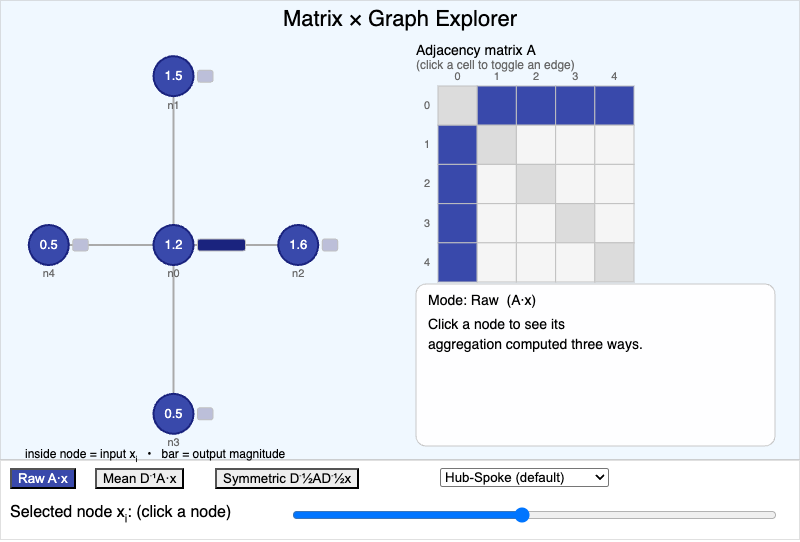
Compare raw (A·x), mean (D⁻¹A·x), and symmetric (D⁻½AD⁻½x) aggregation on a small graph and see why GCN uses symmetric normalization.
Chapter 1: Introduction to Graphs and Networks
Graph Property Explorer
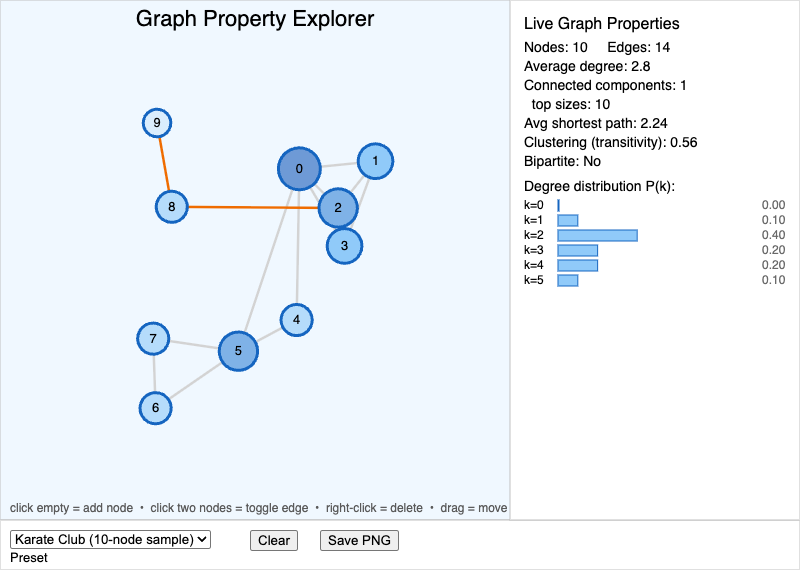
Add and remove nodes and edges and watch degree, neighbors, and graph structure update live.
Chapter 2: Graph Properties and Traditional ML Features
WL Color Refinement Simulator
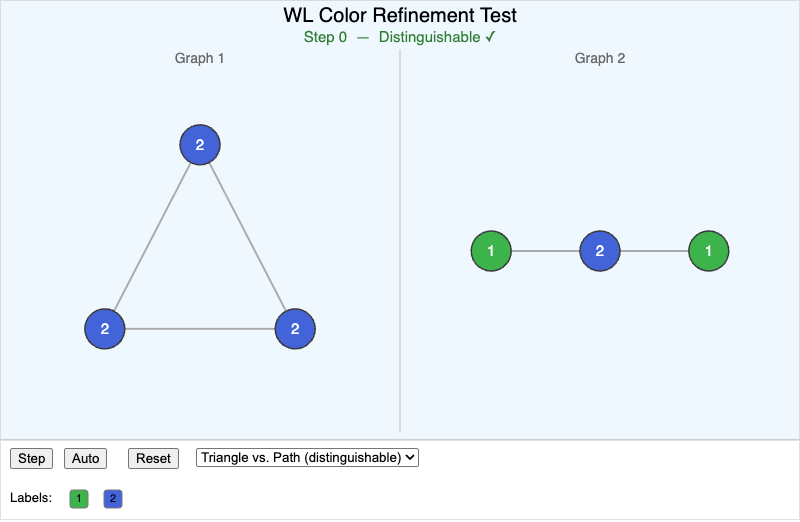
Step through Weisfeiler-Lehman color refinement on two graphs side by side and see when they become distinguishable.
Chapter 3: Link Analysis and PageRank
PageRank Power Iteration Simulator
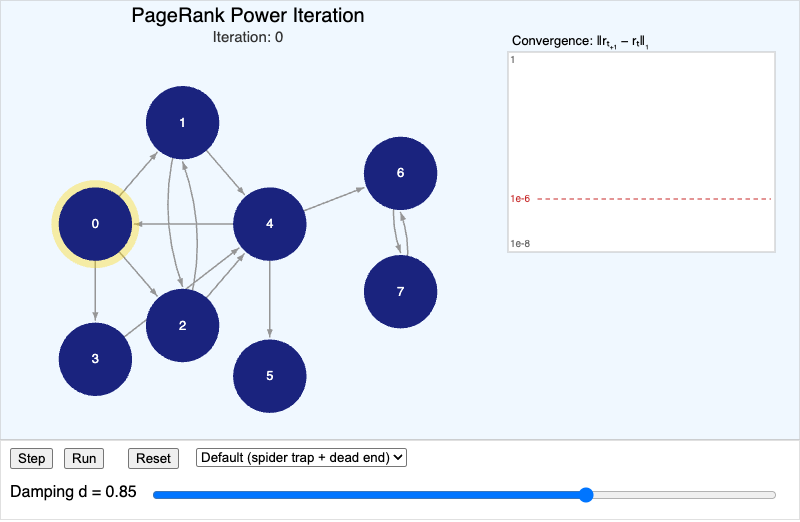
Watch PageRank scores converge through power iteration; node size encodes rank and a slider controls the damping factor.
Chapter 4: Node Embeddings: DeepWalk and node2vec
node2vec Biased Random Walk Explorer
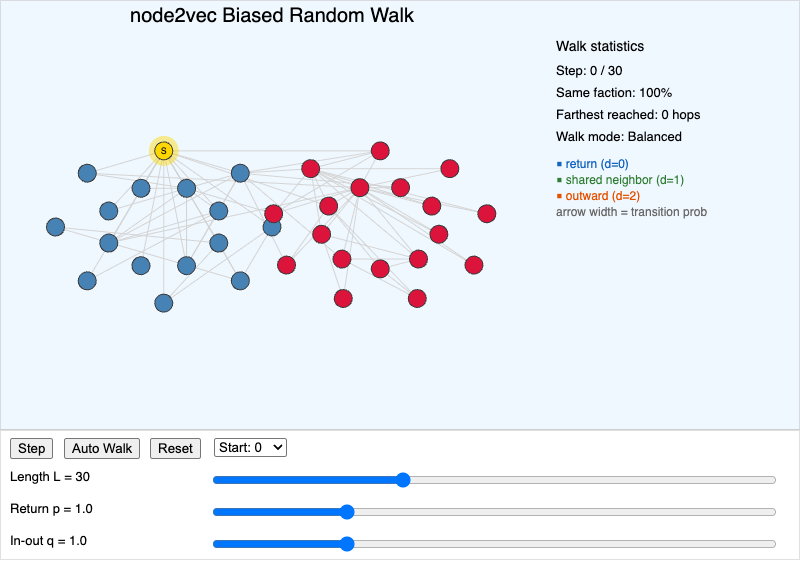
Trace a biased random walk; the p (return) and q (in-out) sliders shift the walk between BFS-like and DFS-like exploration.
Chapter 5: Label Propagation and Semi-Supervised Learning
Label Propagation Step-by-Step Simulator
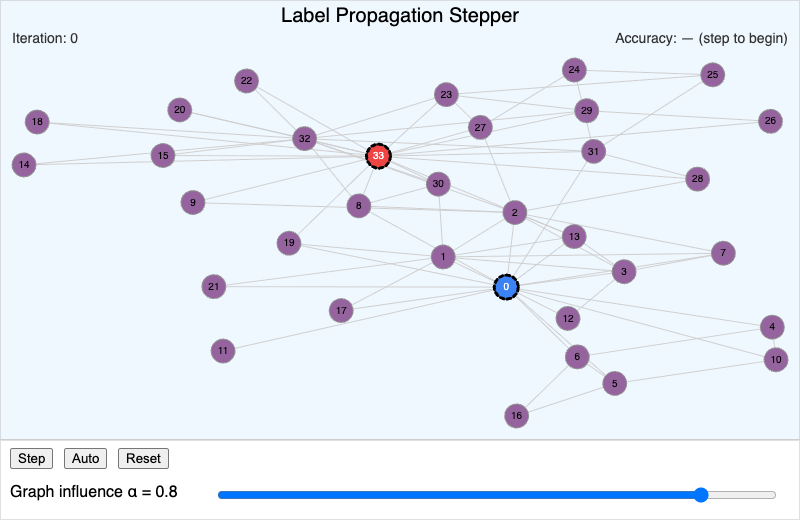
Seed a few labels, then step through propagation rounds and watch labels diffuse across the graph.
SIR Epidemic Dynamics on Network Structures
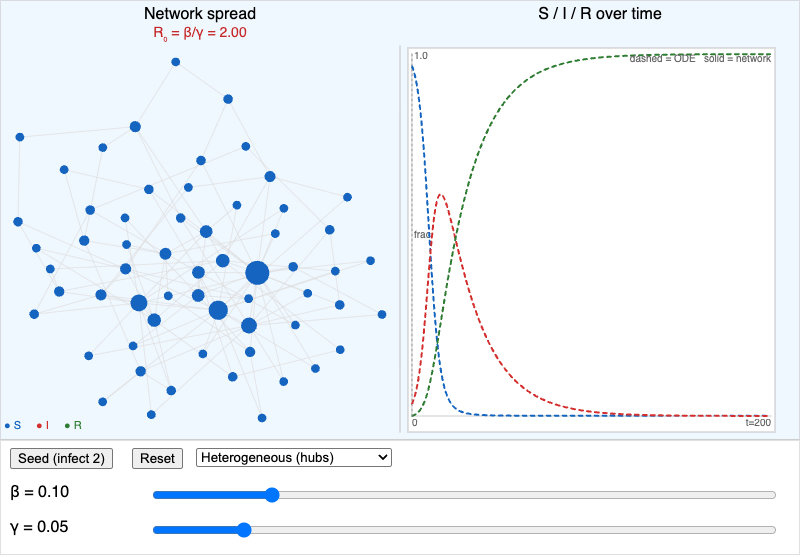
Run an SIR epidemic over different network structures and see how topology drives how fast an infection spreads.
Chapter 6: GNN Foundations: Message Passing and GCN
GCN Message Passing Visualizer
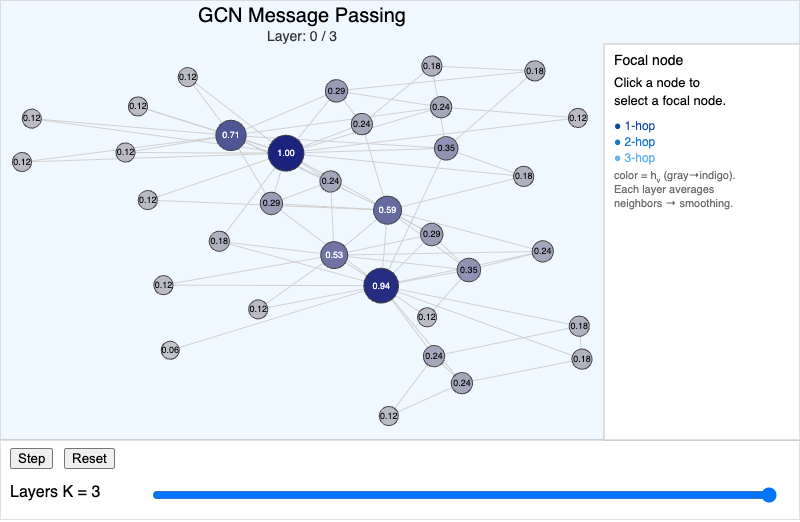
Click a node and watch messages aggregate from its neighbors across 1, 2, and 3 GCN layers.
Spectral vs. Spatial GNN Explorer
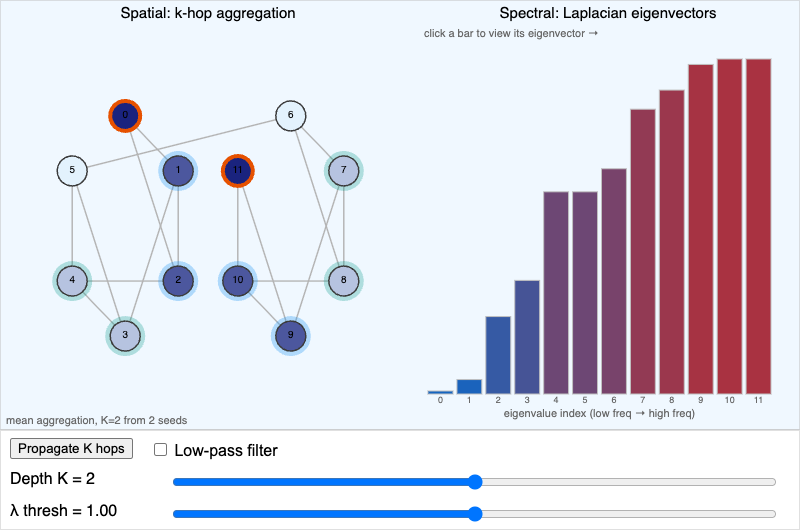
Connect the spectral (eigenvalue) and spatial (message-passing) views of graph convolution.
Chapter 7: GNN Design Space: GraphSAGE and GAT
GAT Attention Weight Visualizer
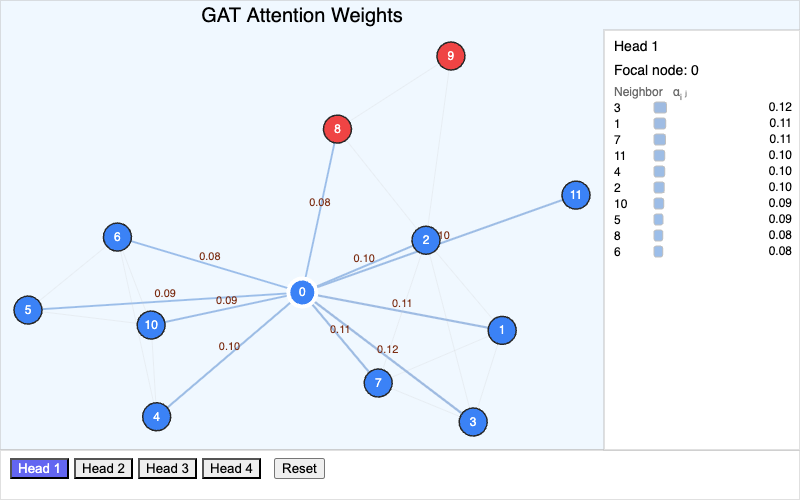
Hover a node to see its softmax attention weights; edge thickness encodes how much each neighbor contributes.
GNN Design Space Interactive Comparison
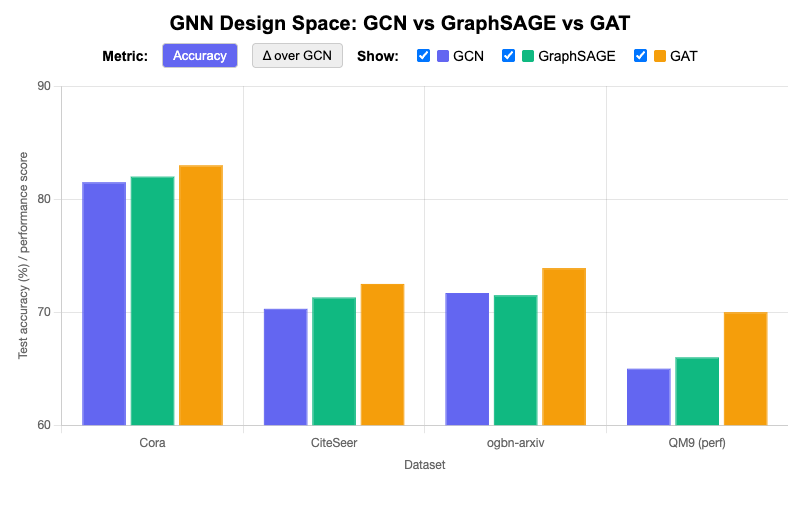
Compare GNN design-space choices (aggregation, layers, skip connections) and their effect on accuracy.
Chapter 8: GNN Training, Augmentation, and Practical Tips
GNN Training Dynamics MicroSim
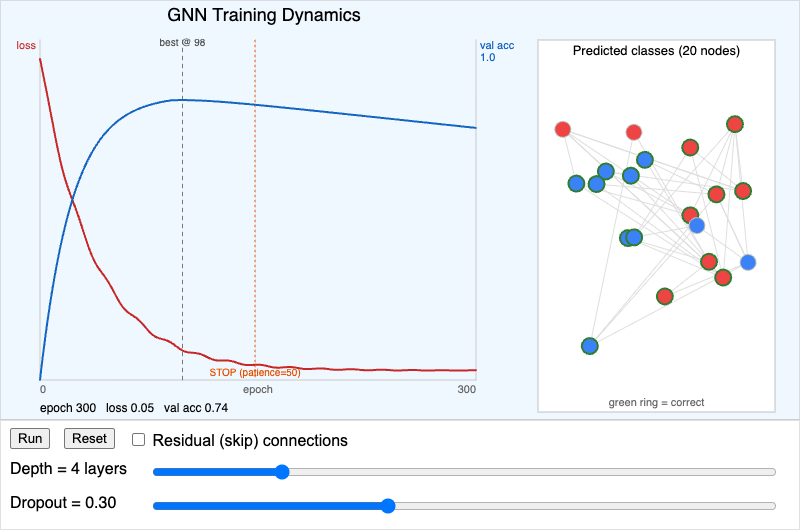
Watch loss and accuracy curves evolve over epochs and toggle train/validation/test splits.
Chapter 9: Theory of GNNs: Expressiveness and the WL Test
WL Refinement MicroSim
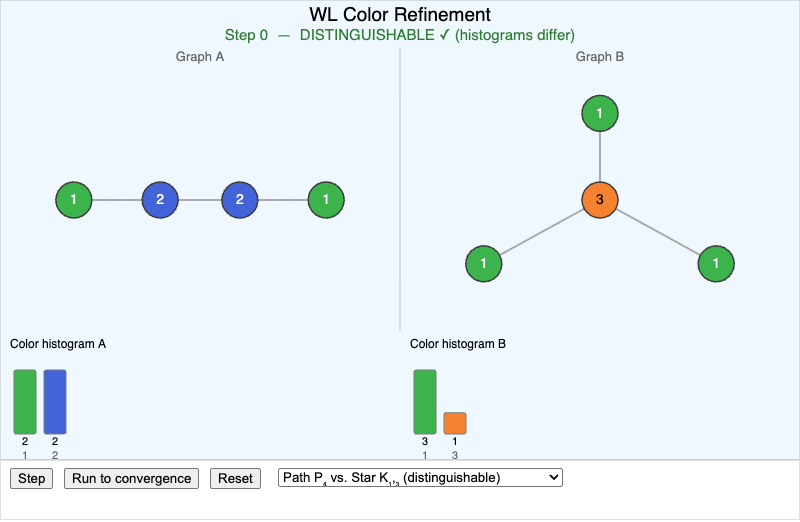
Run the WL isomorphism test and see the canonical cases where two non-isomorphic graphs fool 1-WL.
Chapter 10: Designing Powerful Encoders: GIN and Beyond
GIN vs. GCN Expressiveness MicroSim
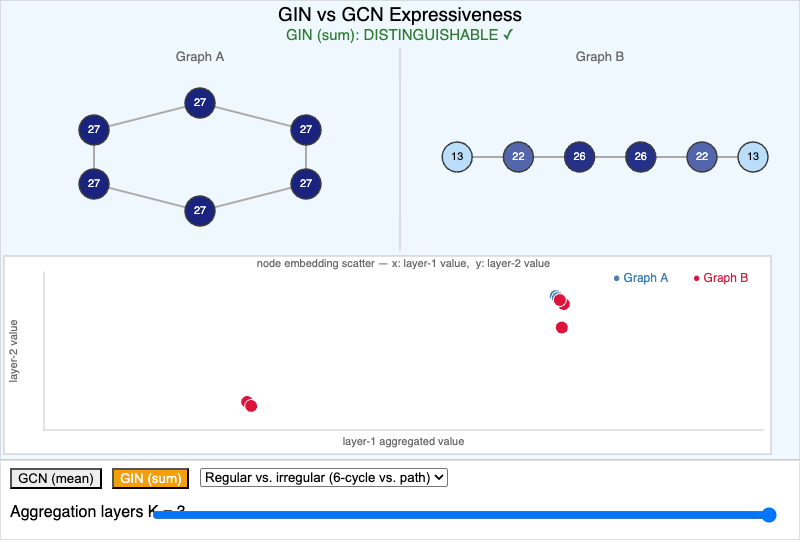
On a 3-regular graph pair, GCN assigns identical embeddings while GIN tells the graphs apart.
Chapter 11: Graph Transformers
Graph Transformer Attention Heatmap
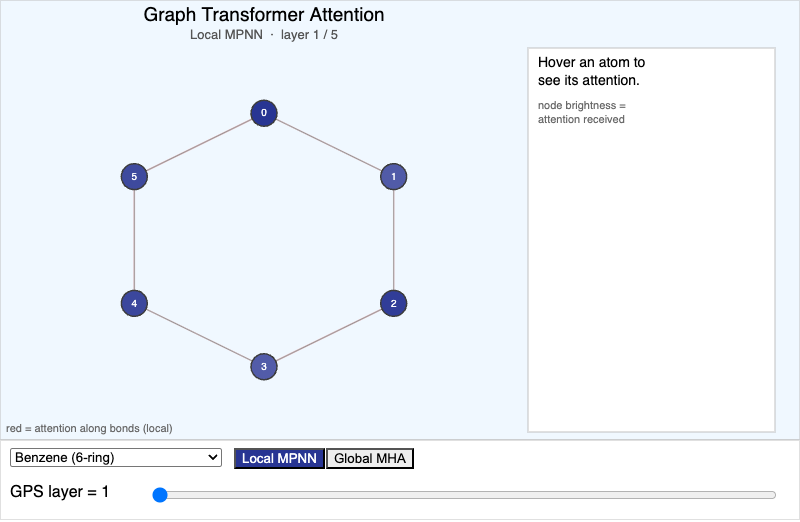
Explore full graph-transformer attention as a heatmap and per-node query/key/value vectors.
Chapter 12: Knowledge Graph Embeddings
TransE Embedding Geometry
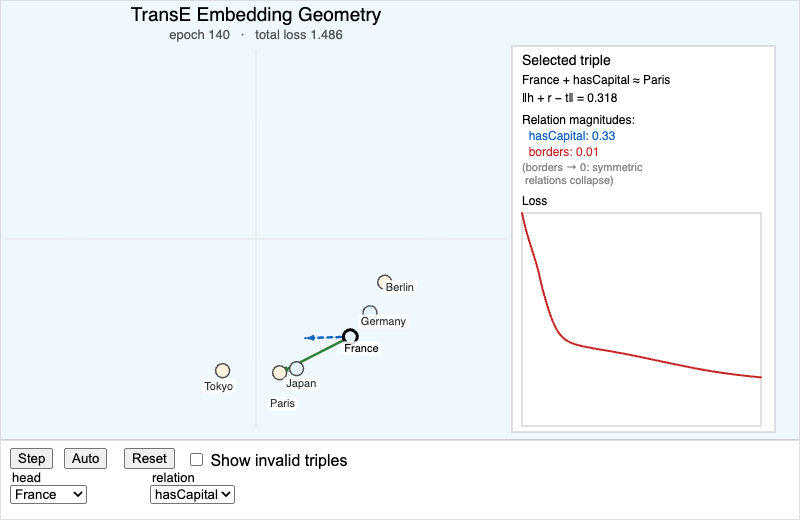
Drag head, relation, and tail vectors in 2D; a triple is valid when h + r ≈ t (TransE).
Chapter 13: Reasoning over Knowledge Graphs
Query2Box Multi-Hop Traversal
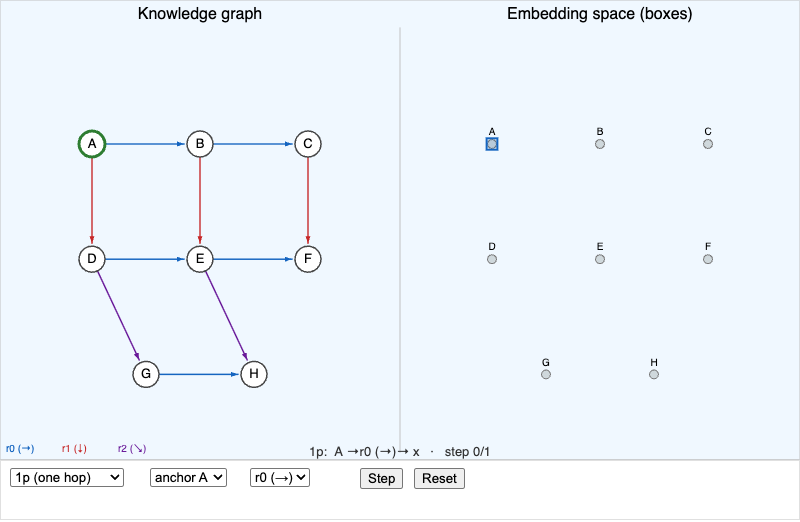
Walk a Query2Box multi-hop query through projection and intersection over a knowledge graph.
Chapter 14: Knowledge Graph Foundation Models
Cross-KG Structure Transfer
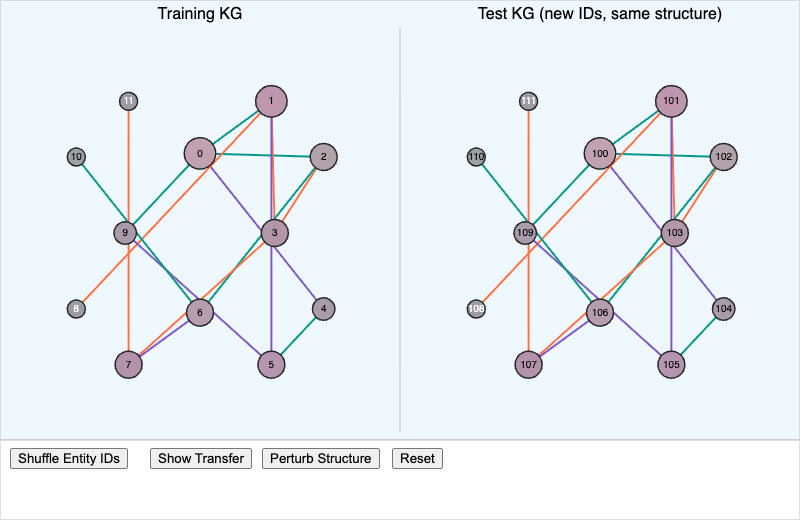
Project entity and relation vectors to 2D and explore zero-shot transfer across knowledge graphs.
Chapter 15: Heterogeneous Graphs
Typed Node and Edge Explorer
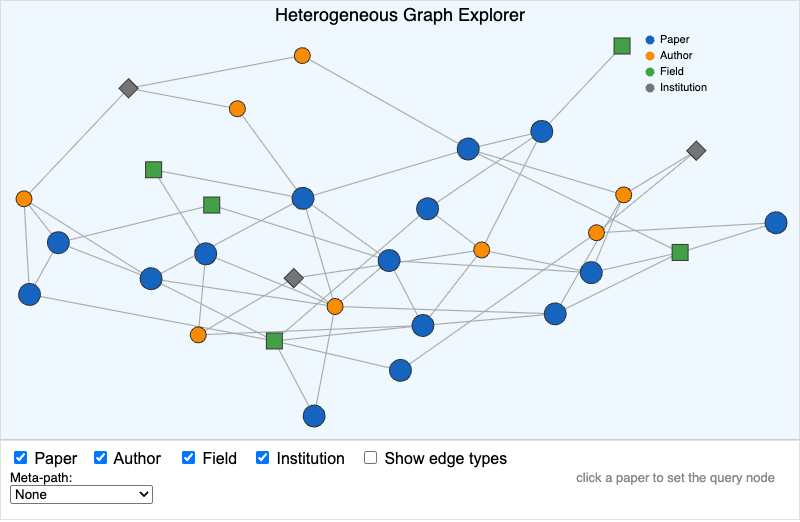
Toggle node and edge types on and off and trace metapaths through a heterogeneous graph.
Chapter 16: GNNs for Recommender Systems
User-Item Graph with Multi-Hop Propagation Visualization
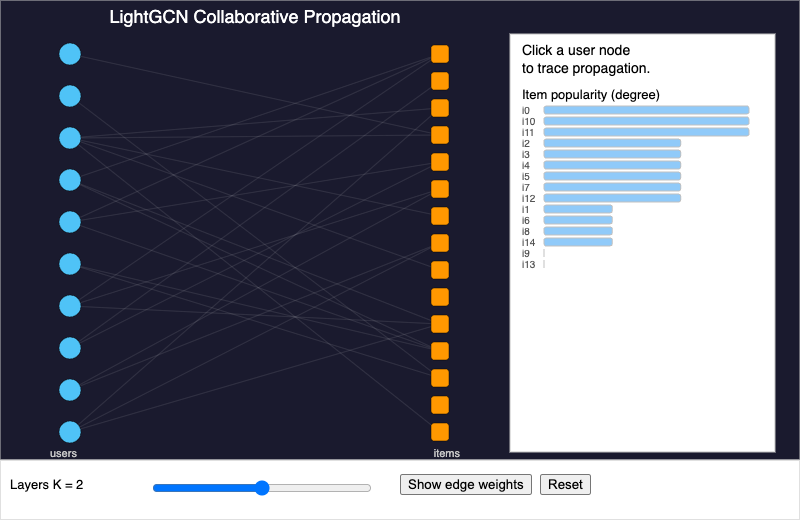
Propagate over a user-item bipartite graph and see how multi-hop signal powers recommendations.
Chapter 17: Relational Deep Learning
Relational Schema to Heterogeneous Graph
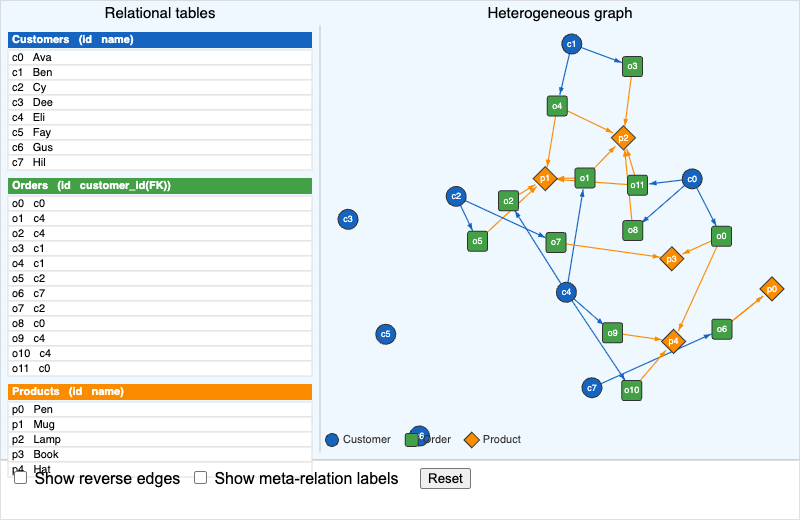
Turn three relational tables (Users, Products, Purchases) into a typed heterogeneous graph.
Chapter 18: Community Structure in Networks
Girvan-Newman Step-by-Step on the Karate Club Graph
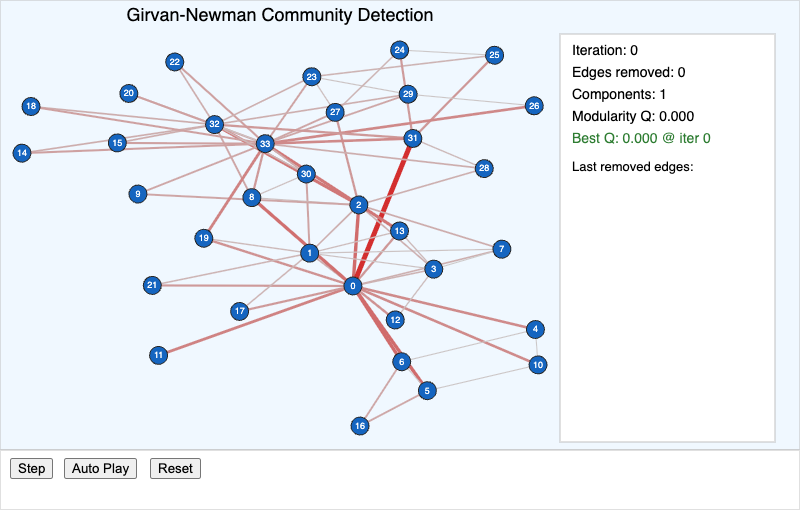
Run Girvan-Newman edge-betweenness splitting on the Karate Club graph and watch communities emerge.
Louvain Two-Phase Iteration Explorer
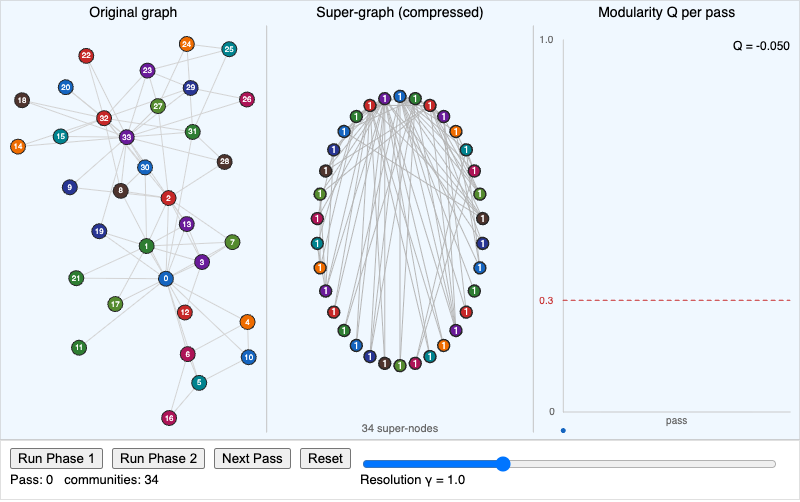
Step through the two phases of Louvain modularity optimization and watch the score climb.
Chapter 19: Frequent Subgraph Mining
Motif Z-Score Explorer
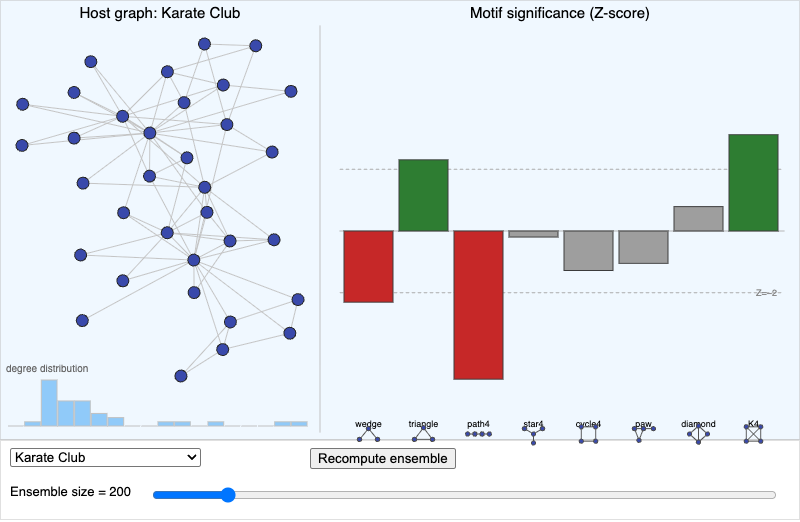
Census 3- and 4-node subgraphs and compare counts against a random null model to get motif Z-scores.
SPMiner Order Embedding Space
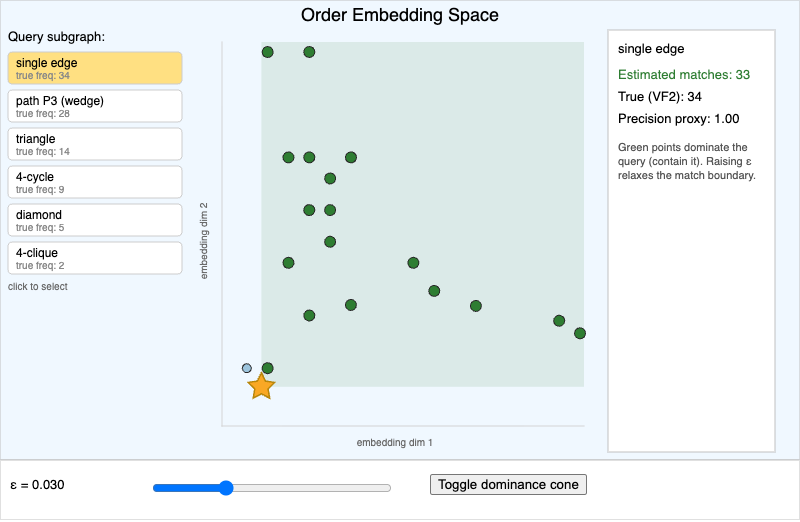
Explore an order-embedding space where subgraph containment becomes a geometric relationship.
Chapter 20: Scaling GNNs to Billion-Node Graphs
SIGN Architecture vs. Neighbor Sampling Architecture
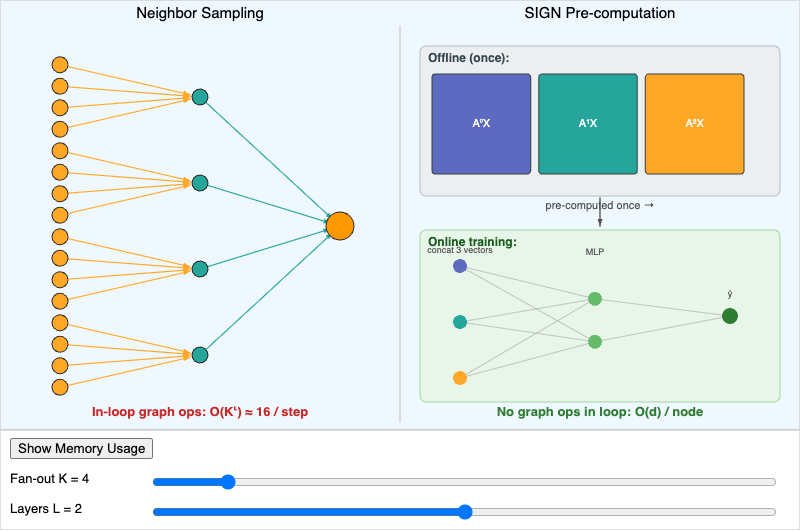
Contrast precompute-then-train (SIGN) against neighbor sampling for scaling GNNs to large graphs.
Chapter 21: Deep Generative Models for Graphs
Drug Discovery GNN Pipeline
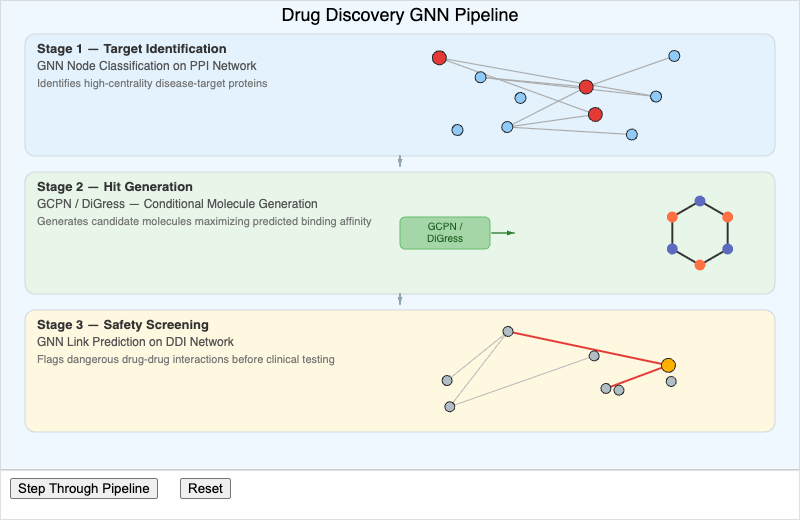
Step through a molecular-graph GNN pipeline from molecule to property prediction.
Chapter 22: Temporal and Dynamic Graphs
Traffic Forecasting Architecture — MicroSim
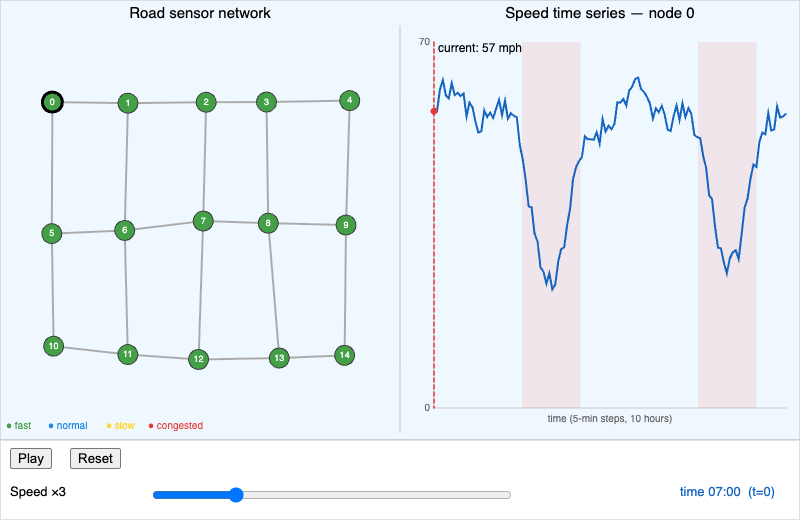
See how a spatio-temporal GNN forecasts traffic by combining road structure with time.
Chapter 23: LLMs and GNNs: Text-Attributed Graphs and Joint Training
LLM+GNN Pipeline Explorer (Full Version)
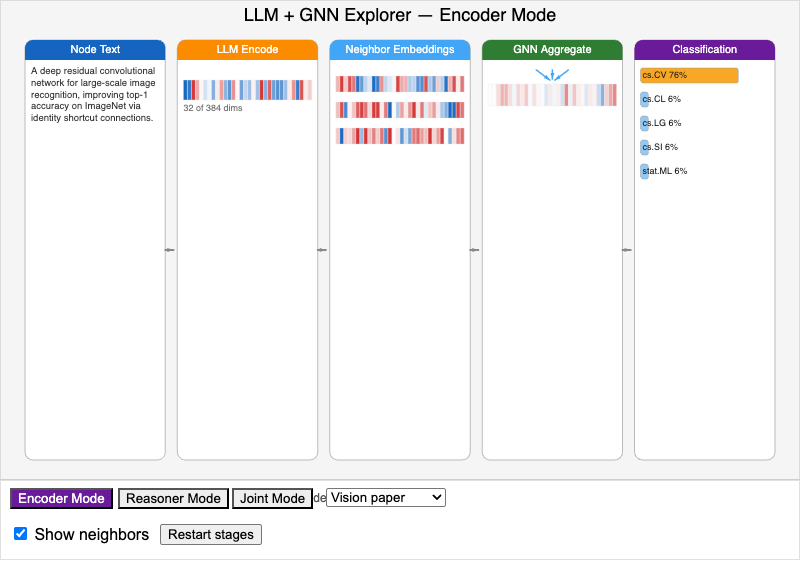
Explore how text-attributed graphs combine LLM text encoders with GNN message passing.
LLM+GNN Pipeline — Text-to-Prediction
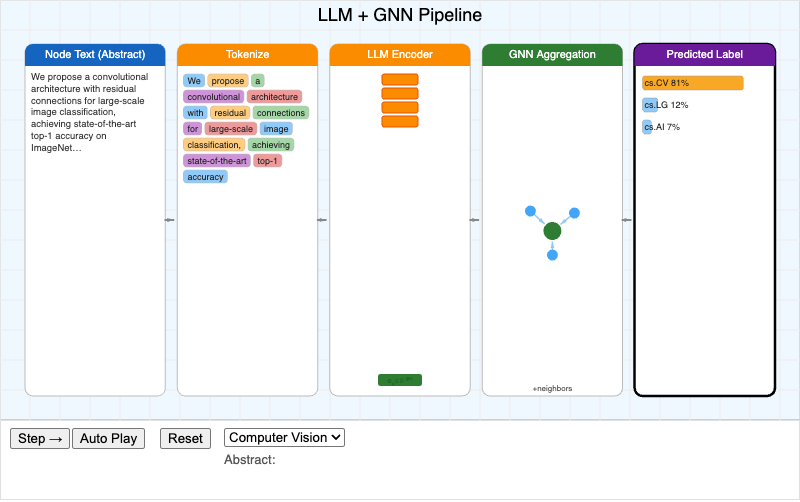
Follow one node from raw text → LLM embedding → GNN aggregation → final prediction, with dimension bars at each stage.
Chapter 24: Advanced GNN Topics: In-Context Learning and Uncertainty
Contrastive Loss Surface Explorer
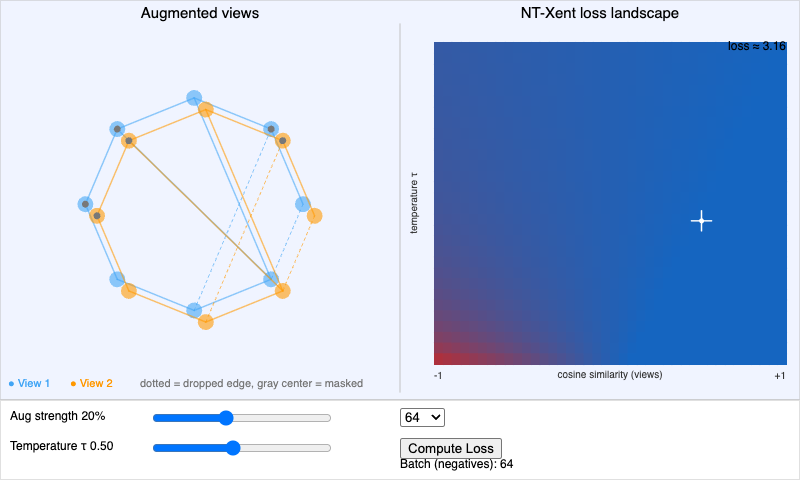
Move augmentation strength and temperature across the NT-Xent loss landscape and read the operating point.
Graph Contrastive Learning — Two-View Pipeline
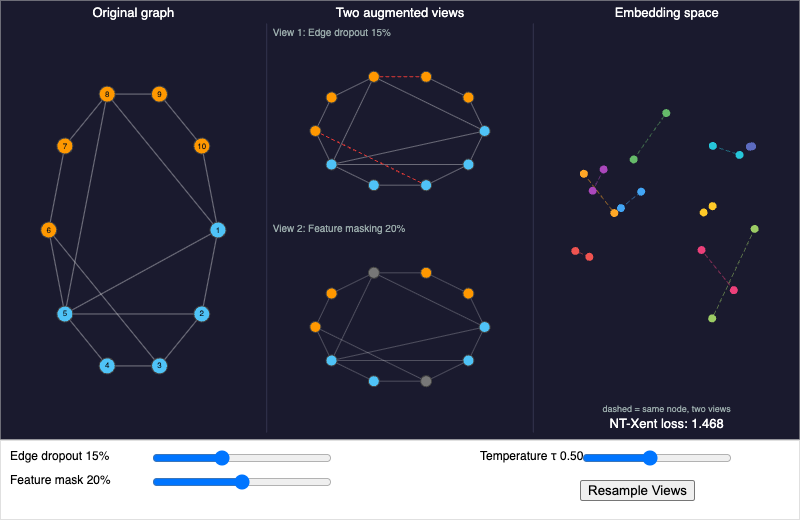
Build two augmented views of a graph and pull matching node embeddings together while pushing others apart.
DGI vs. Contrastive Learning — Concept Map
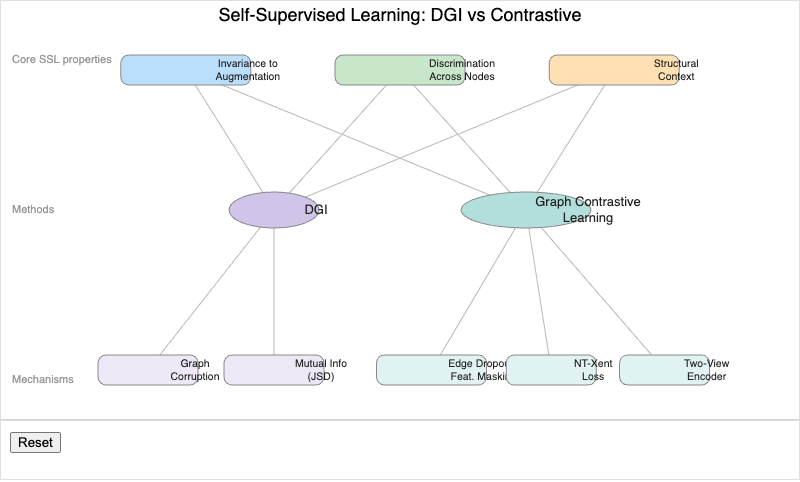
Compare DGI and graph contrastive learning against the three core self-supervised-learning properties.
Chapter 25: Agents and Graphs
Multi-Hop KG Reasoning Agent
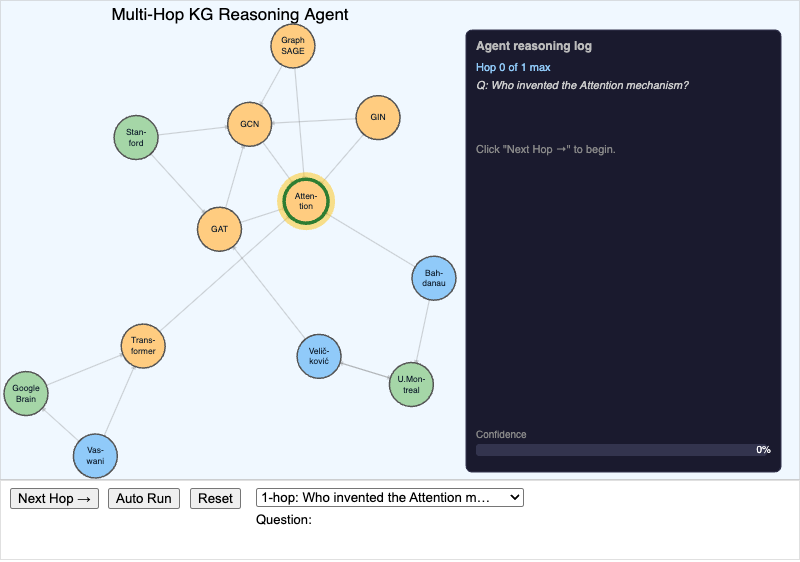
Watch an agent answer a multi-hop question over a knowledge graph, tracing retrieved nodes and confidence per hop.
Agent Tool-Use Graph — Interactive Planner
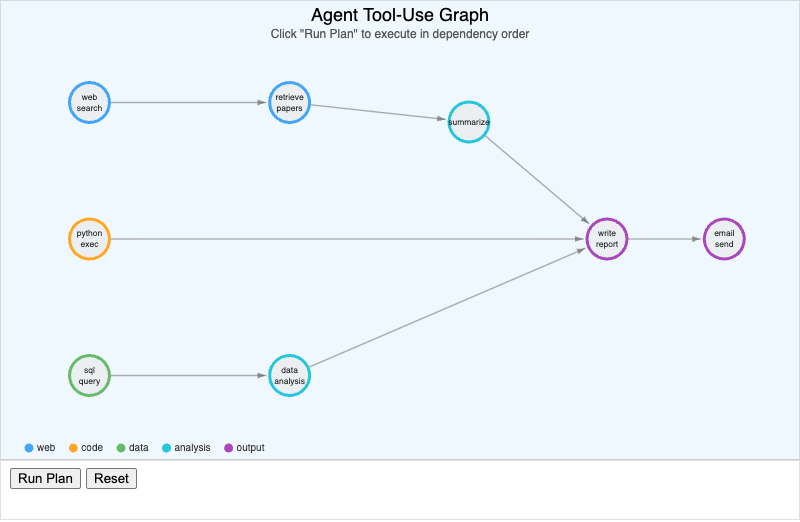
Run an agent's tool-use plan as a dependency graph; independent tools fire in parallel waves.
Chapter 26: Conclusion — The GNN Design Space and Open Problems
GNN Architecture Family Tree
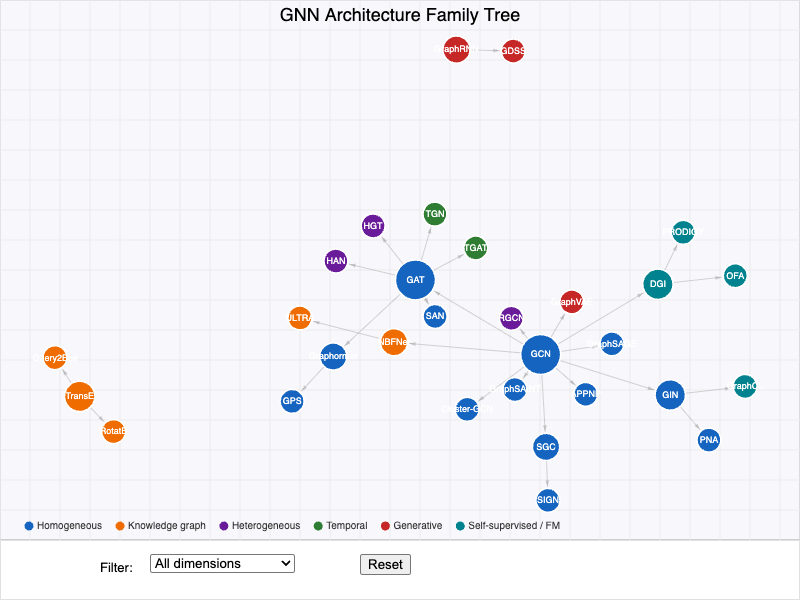
Browse an interactive taxonomy of GNN architectures with 'extends / inspired by' lineage edges.